
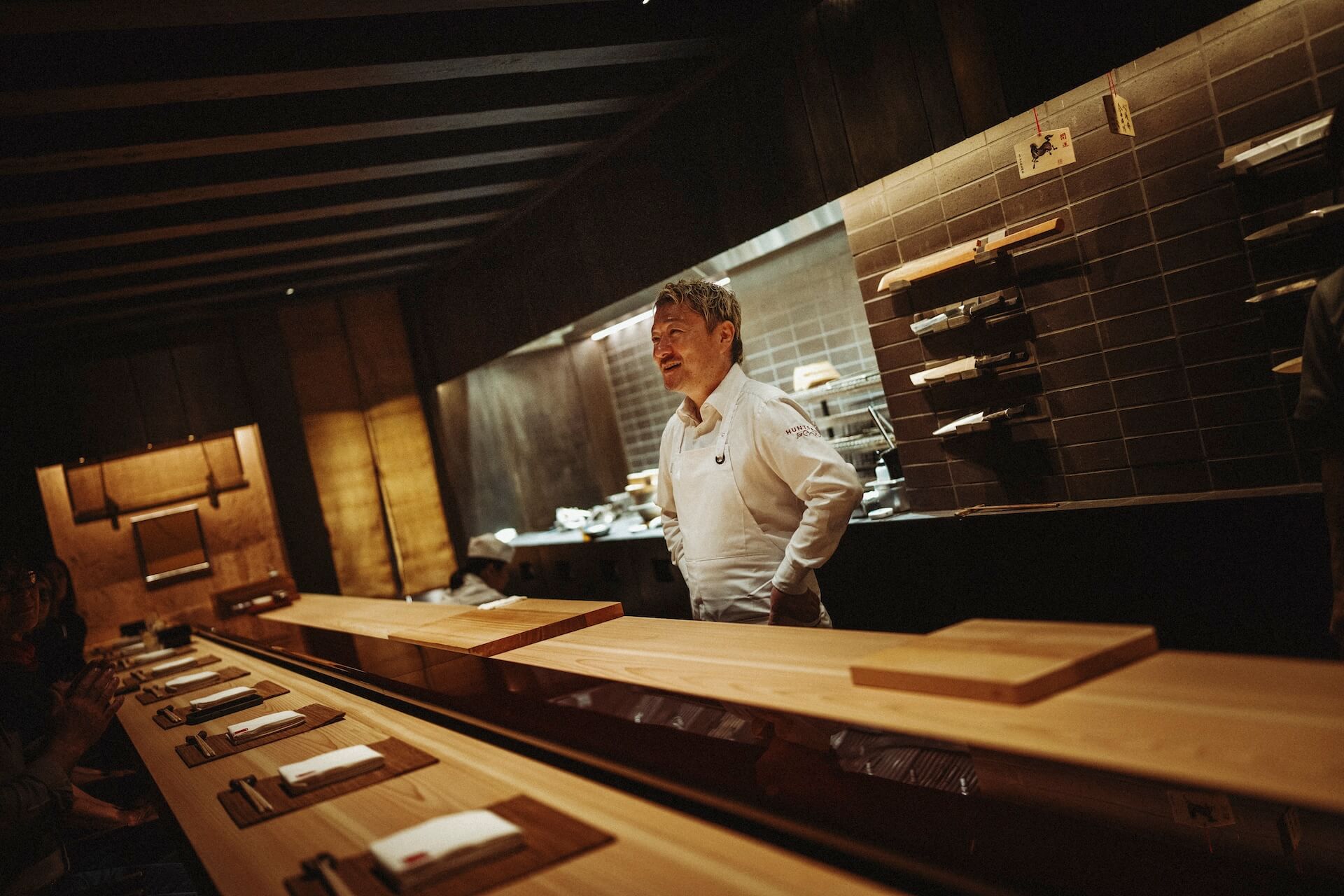
Endo Kazutoshi returns with a new 10-seat omakase restaurant in Chelsea
London’s fine-dining scene has welcomed back one of its most distinctive Japanese chefs. Endo Kazutoshi has opened ENDO, an intimate 10-seat omakase restaurant in Chelsea, marking his return to a permanent restaurant kitchen following the devastating fire that forced the closure of his Michelin-starred Endo at the Rotunda in September 2025.
Located in a former Chelsea townhouse, the new restaurant takes a more personal approach to Japanese dining, drawing on the chef’s family heritage, traditional sushi craftsmanship and ingredients sourced from both Japan and the British Isles. Upstairs, a separate listening bar, Moga, adds another dimension to the experience.
For Kazutoshi, however, this is about more than opening another restaurant. It represents a continuation of a career shaped by generations of sushi-making and a determination to bring that tradition into the future.
A new beginning after the Rotunda fire
Kazutoshi’s previous restaurant, Endo at the Rotunda in White City, established itself as one of London’s leading Japanese dining experiences after opening in 2019. It received a Michelin star in the 2020 Michelin Guide Great Britain and Ireland and became particularly well known for its intimate sushi counter and distinctive omakase menus.
That chapter came to an abrupt halt on 6 September 2025, when a major fire damaged the Helios building housing the restaurant. Although all members of the restaurant team were safe, the damage meant the Rotunda had to close indefinitely.
Following a five-month residency at Mayfair private members’ club Annabel’s, Kazutoshi has now returned with a permanent home in Chelsea.
ENDO opened on 1 October 2026 at 8–9 Blacklands Terrace, taking over the former site of the Michelin-starred Five Fields.
The chef has described the new restaurant as a continuation of his previous work rather than a complete reinvention. Its inspiration comes partly from his great-grandfather’s sushi restaurant in Yokohama and the traditional omakase counters of Tokyo during the 1920s and 1930s.
Just ten seats at the sushi counter
The restaurant’s defining feature is its ten-seat counter, where Kazutoshi prepares and presents the food directly in front of guests.
The interior moves away from the familiar minimalist aesthetic often associated with contemporary Japanese restaurants. Instead, the design uses dark timber, brick and traditional Japanese references to create a more atmospheric setting.
At its centre is a sushi counter made from 200-year-old Kyoto hinoki wood, a highly regarded Japanese cypress traditionally used in architecture and craftsmanship.
The ingredients receive similar attention. Nori seaweed is sourced from Hayashiya at Tokyo’s Toyosu Market, while the restaurant uses double-brewed soy sauce from Kajita Shoten, a Japanese producer whose history dates back to 1874.
Kazutoshi is a third-generation sushi master, having grown up around the traditions of Japanese sushi-making. His approach combines techniques passed down through generations with ingredients from carefully selected suppliers.
British produce also plays an important role. Fish is sourced from the waters around the British Isles, with the selection changing according to the season and available catch.
The experience extends beyond nigiri, the hand-pressed sushi commonly associated with traditional sushi counters. Guests can expect a changing sequence of dishes incorporating seafood, noodles, meat and seasonal vegetables.
Among the more elaborate preparations is a langoustine nigiri that has undergone years of development. The claw is steamed, while the head is grilled and its meat combined with N25 kaluga caviar marinated in kombu.
Other dishes have included Nagasaki-style udon noodles served in a delicate broth and Miyazaki wagyu accompanied by Japanese green onion and a sweet-savoury sauce.
The idea is to create a complete dining experience rather than simply a succession of sushi courses.
Moga: A Japanese-inspired listening bar
The restaurant is only part of the new Chelsea project.
Upstairs, Moga is a listening bar inspired by Japan’s Taishō era, a period spanning 1912 to 1926 when Japanese culture experienced significant social and artistic change alongside growing Western influences.
The space takes a different direction from the sushi restaurant below, with custom Taguchi speakers, vinyl records and a drinks programme developed in collaboration with London tea specialists Postcard Teas.
Its menu draws on Kazutoshi’s travels through cities including Paris, Milan, Madrid, Hong Kong and Tokyo. Dishes include a red mullet sandwich, previously popular at the Rotunda, and Cocido Madrileño, a traditional Spanish chickpea stew.
Moga initially opened exclusively to restaurant guests, with separate public bookings announced for December 2026.
It gives the project an additional social dimension, offering something beyond the traditional sushi-counter format.
A restaurant looking towards the future
There is a clear sense of continuity running through ENDO Chelsea. From the use of traditional Japanese ingredients to the emphasis on seasonal British seafood, Kazutoshi appears intent on preserving the principles that made his previous restaurant successful while giving them room to develop.
The limited number of seats also means the experience is likely to remain highly personal, with the chef directly involved in preparing and presenting the food.
Demand has already been significant. Reservations for November and December reportedly sold out within six minutes of becoming available, with the restaurant subsequently operating a waiting list for cancellations.
For London diners, ENDO represents the return of a chef whose previous restaurant helped establish the capital as a serious destination for high-end Japanese dining.
And while the Rotunda remains an important part of his story, Chelsea looks set to become the next chapter.
ENDO
8–9 Blacklands Terrace, London SW3 2SP
Restaurant reservations: Wednesday to Saturday, with sittings at 5.45pm and 8.45pm. November and December 2026 reservations are currently fully booked, with a waiting list available through the restaurant’s website.
At a glance
ENDO Chelsea
Cuisine: Japanese – Edomae-style sushi and omakase
Location: 8–9 Blacklands Terrace, Chelsea, London SW3 2SP
Style: Intimate 10-seat omakase counter
Price: Not confirmed
Best for: Japanese sushi craftsmanship, seasonal seafood and an intimate dining experience
Michelin status: Chef’s previous restaurant, Endo at the Rotunda, held one Michelin star. No Michelin star confirmed for ENDO Chelsea.
Foodoholism verdict: A compelling return from one of London’s best-known sushi chefs, combining traditional Japanese techniques with exceptional British seafood and a highly personal dining experience.
